


Blog
The Science Behind Beer Coloration: What It Reveals About Your Brew – BeerSmith Dwelling Brewing Weblog


This week I check out beer colour, how it’s measured, the place it comes from and the way colour performs a serious function in your beer brewing.
The Historical past of Beer Coloration and Its Measurement
As an attention-grabbing facet observe, a big portion of historic beers have been very possible darkish and even deep brown, as nearly all of malts have been traditionally dried over wooden till the invention of coke fired kilns within the 1700’s. The lighter coloured pilsners, pales, and IPAs are a reasonably current invention.
The primary system to measure and characterize beer colour was created by J.W. Lovibond in 1883 and bears his title. The Lovibond system used a sequence of coloured slides or glass requirements that have been in comparison with beer colour to find out the Lovibond colour in “levels Lovibond. This coloring system continues to be in extensive use for measuring malt colour, significantly within the USA. The lovibond scale is present within the malt colour wheel picture under.
In 1950 the American Society of Brewing Chemists adopted the Normal Reference Methodology (SRM) system for measuring beer colour. On this system, a tool is used to measure the attenuation of sunshine at 430 nm passing via a couvette containing 1 cm of beer, after which scaling it by a relentless worth of 12.7. This method was picked to roughly match the outdated Lovibond scale, so the 2 scales are roughly equal.
Later the European Brewery Conference (EBC) established a separate scale that additionally measures the absorbance of sunshine with a 430 nm beam in a 1 cm vial, but it surely makes use of a relentless of 25. Due to this you possibly can simply convert from SRM to EBC utilizing an approximation of two or for a extra exact outcome:
EBC =1.97 * SRM
SRM = EBC/1.97
The SRM and EBC scales have largely changed Lovibond except malt colour which is commonly nonetheless expressed in Lovibond. Since the entire methods above measure colour as a single quantity, they will’t actually seize the complete spectrum of beer colour potentialities. If we consider the easy Crimson-Inexperienced-Blue-Alpha system to simulate colours on a pc display screen it requires not less than 4 dimensions. In consequence these scales can’t actually seize the refined purple colour of an Irish Crimson Ale or berry, orange or purple colour of a fruit beer.
The place Beer Coloration Comes From
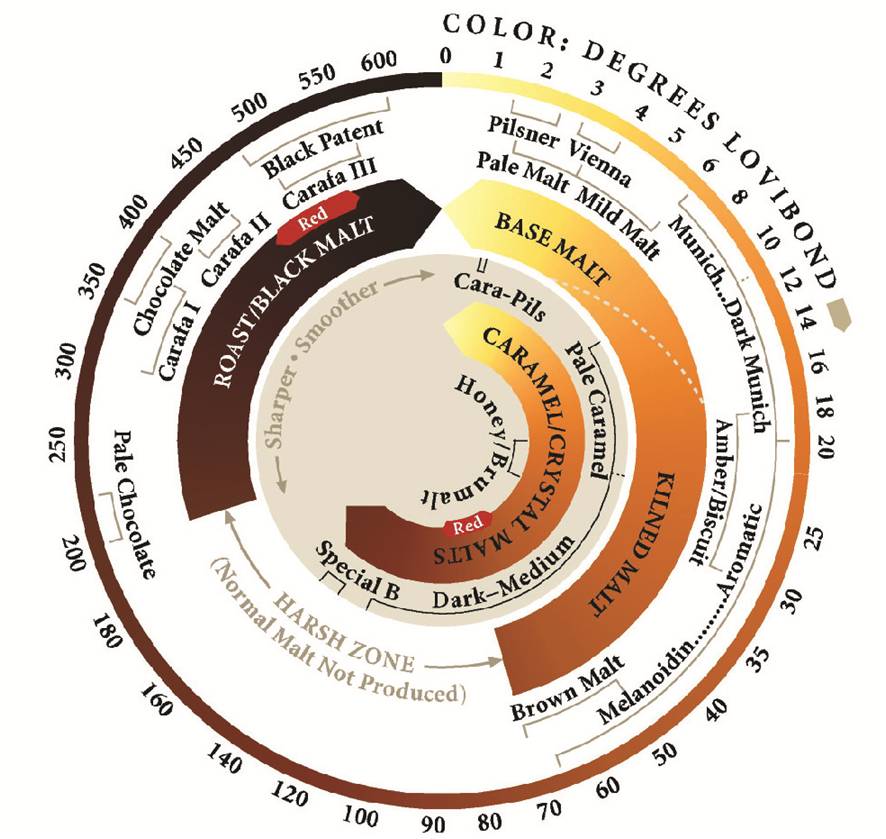
The overwhelming majority of the colour in our beer comes immediately from the malts used. Darker malts result in darker beer. Randy Mosher has captured the malt wheel to the proper which reveals malt colour in levels lovibond for the 4 main malt teams. Additionally you possibly can simply estimate the colour of a completed beer utilizing software program like my BeerSmith brewing software program or a the Morey system lined right here.
The overwhelming majority of malt utilized in brewing is base malt which is the palest of malts, with colours for many base malts within the 2-6 lovibond vary. Subsequent now we have the kilned malts that are kilned at a better temperature for an extended interval than base malt which leads to a darker end. These malts are darkened by the maillard response which has similarities to the response that darkens bread whenever you toast it or different meals whenever you prepare dinner them.
Caramel and Crystal malts are made in a barely totally different means, however present an identical colour vary to kilned malts. These malts are kilned moist which leads to a barely totally different caramelization response that darkens the malt by way of maillard reactions but in addition leaves residual sweetness from the crystalized sugars contained in the grain.
The darkest malt group is the roast/black malt group. These malts are roasted which really depends on a unique chemical course of known as pyrolysis which because the title implies is mainly a burning course of that takes place at excessive temperature. I did a podcast episode with Randy Mosher discussing malt kilning and maillard reactions right here if you wish to study extra.
Relating Beer Coloration to Taste
There isn’t any strict information that ties beer colour to a given taste. If you’re artistic you possibly can create a reasonably darkish coloured beer that tastes precisely like a pale ale or a beer that’s mild in colour and tastes like a stout. Nonetheless, normally, darker beers are likely to include extra kilned, darkish crystal or roast malts which creates the flavors we affiliate with brown ales, porters and stouts. Equally lighter coloured beers lack numerous the toasted or roasted hints and as an alternative spotlight a clear hoppy or pale end we affiliate with lagers, IPAs and ales.
Nonetheless the precise flavors the assorted malt teams present is sort of various. A equally coloured brown and darkish crystal malt should not have the identical taste profile, so the identical beer constituted of each won’t have the identical taste even when the colour is identical. If you would like a great place to begin to grasp the flavors which are related to the foremost malt teams I like to recommend you begin with this text in addition to the person articles on every malt group linked into this text. Understanding the flavors that particular person malts present to the entire can actually enable you develop as a beer designer and brewer.
I hope you loved this week’s article on the colour of beer and malts. Thanks for becoming a member of me on the BeerSmith Dwelling Brewing Weblog. If you wish to take the guesswork out of brewing, please strive my BeerSmith 4 recipe software program from BeerSmith.com. Make sure to join my e-newsletter or my podcast (additionally on itunes and youtube) for extra nice tips about homebrewing.